
The world’s first Agree-athon in Hereford
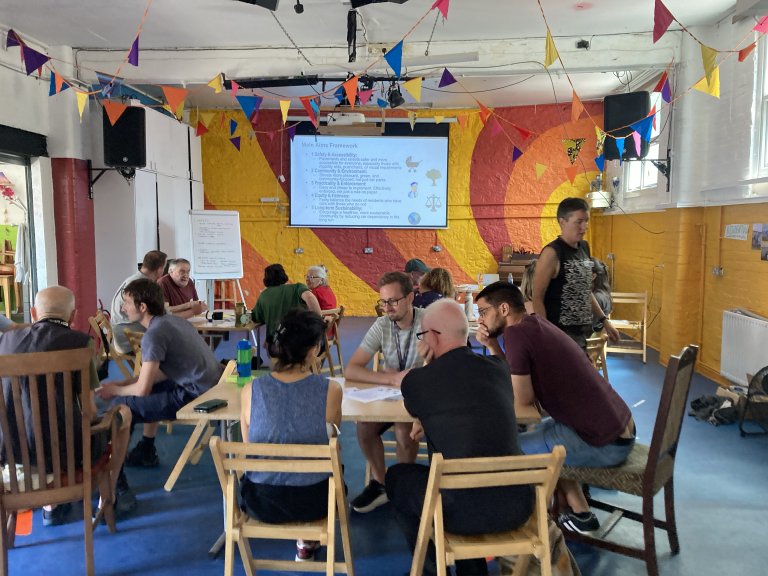
On Friday 13th March, the Left Bank in Hereford witnessed the world’s first Agree-athon. There are so many mechanisms in the media and in politics to divide us, so few to unite. The Agree-athon aimed to show that there is common ground between different political parties.
Five parties were represented. The Labour party by Paul Dawson, local chair; Independents for Herefordshire, by the leader, Liz Harvey; the LibDems, by councillor Ben Proctor; the Greens, by local chair Edward Milford; and the Conservatives, by Michael Gray, also local chair. Reform and Your Party were invited but did not reply.
The crucial piece of equipment was that everyone, panellists and audience alike, had a yellow card which they could wave at certain points, if they found a proposal unacceptable. They were then invited to give their reasons, as feedback to the proposer.
Paul started by proposing fluoridation of water, to improve children’s teeth. Liz put the case for “None of the above” (NOTA) on ballot papers, so that voters can show that they reject every candidate without spoiling their ballot paper. Ben argued for decriminalising cannabis: better a regulated market. Edward Milford wanted GDP abandoned as a measure of progress. Finally, Michael said that social media was addictive and damaging for children, and should not be available for under 16s.
All secured some agreement from the others. Some more, some less, Michael the most.
hat-tip to DeliberAIDe who created this record of the Agree-athon
But this blog is not really about the topics.
It is about the possibility of redesigning politics so that discussion begins with the ‘why’, the underlying aims, values and principles. There is far more common ground here than at the level of ‘what’ should be done – policies and solutions. Establishing a shared ‘why’ gives us a much better chance of finding policies that work for all of us – Win-Win.
What did we learn? First, politicians are drawn to ‘what’ like children to puddles. Next time, we’ll divide each politician’s time into two, so that once they’ve named their idea, they have to state their underlying aims, and if possible secure the agreement of others. Only then will they move on to policies.
Second, there were one or two fascinating clashes of principle. Paul’s arguments about the effectiveness and fairness of fluoridation dramatically ran into objections from people concerned about the need for consent. Our experience over the last five years with the Win-Win Workout suggests that such differences can often be reconciled, but that would need a whole event of its own.
Third, people can agree that a policy is desirable, but disagree as to whether it is feasible. Some were sceptical that the market for cannabis, should it be legalised, would be properly regulated. Perhaps next time we should do more to separate out these two elements.
Fourth, it’s hard to adjust your policy to meet the needs of others when you are advocating a policy that is owned by an organisation to which you feel committed. Liz would have secured much more agreement to NOTA had she felt able to give up that part of the NOTA programme which states that, in extreme cases, a general election will have to be re-run. Edward would have found more support for other measures of progress had he been prepared to have GDP as part of his basket of indicators.